




Homepage |
COP31 | MEX Jointly Launches 2025 State of the Asian Carbon Credit Market Report with Institutions from Three Countries
Release time: 2026-11-11
Press Release
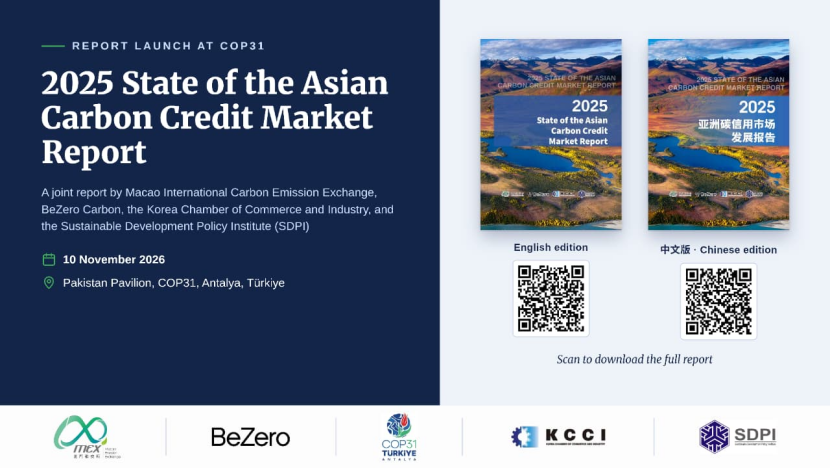
On the second day of COP31 (November 10), the Chinese and English versions of the 2025 State of the Asian Carbon Credit Market Report—jointly compiled by the Macao International Carbon Emission Exchange (MEX), BeZero Carbon, the Korea Chamber of Commerce and Industry (KCCI), and the Sustainable Development Policy Institute (SDPI) of Pakistan—were officially launched at the Pakistan Pavilion at COP31. The report shows that in 2025, the Asian carbon credit market underwent a pivotal transformation and reshaping. The main theme of market development shifted from scale expansion to quality prioritization, and the market landscape evolved from unilateral supply export toward a two-way balance of supply and demand.
Data from the report indicates that in 2025, carbon credit issuances from projects in the Asian region reached approximately 110 million tonnes, accounting for 40.74% of total global issuances. Cumulative issuances totaled 1.131 billion tonnes, representing about 47% of the global cumulative total. In terms of retirements, carbon credit retirements from Asian projects reached 74.4 million tonnes in 2025, accounting for 44.29% of global retirements. Notably, the activity of Asian buyers, represented by Chinese enterprises, increased significantly. In 2025, carbon credit retirements by Asian buyers approached 7 million tonnes, a year-on-year increase of 30.4% compared to 2024, demonstrating the accelerating rise of demand-side forces.
Regarding the high-integrity transition, issuances of CCP-labeled carbon credits in the Asian region exceeded 16.05 million tonnes in 2025, representing a year-on-year surge of 98.86% and accounting for nearly half of the global total of CCP-labeled carbon credits. Among the 269 Asian carbon credit projects evaluated by BeZero Carbon, 21% received a rating of BBB or above, a rating threshold that has become a common screening criterion for enterprises procuring high-integrity carbon credits. Between 2022 and 2025, the proportion of retirements of Asian carbon credits rated BBB or above doubled.
Looking ahead to the next five years, the report distills the following key trends:
· First, digital technology empowering market supervision: Technologies such as dMRV, AI, and the Internet of Things (IoT) will further drive the verification of carbon assets and emission reduction outcomes toward data-driven empirical evidence and standardized processes.
· Second, tiered improvement of regional mechanisms: Domestic carbon mechanisms are upgrading from supplementary tools to the international carbon market into core policy instruments supporting Nationally Determined Contributions (NDC) targets.
· Third, high-integrity carbon assets becoming a core capital allocation direction: Nature-based carbon sinks and engineered carbon removal projects with permanence guarantees and rigorous MRV support will become market favorites.
The market faces risks such as tightening host-country policies, geopolitical shocks, the complexity of Article 6 authorization, and mechanism fragmentation. In response, Asian market participants should continue building high-integrity standard systems, deepening Article 6 practices, promoting the integration of technological innovation and financial instruments, and strengthening policy coordination as key levers for the development of the Asian carbon market. In the future, South-South cooperation should be enhanced to elevate the region's voice in global climate governance.
The Asian carbon market is shifting from "quantity first" to "quality first," and high-integrity, traceable carbon credits will become the core competitiveness of the regional market. MEX will continue to leverage Macao's role as a bridge between China and the international community, uniting partners from all sides to promote integrity building and interconnection in the Asian carbon market.
Scan the QR codes to access the full report
Chinese version | English version |
|
|




Popular articles
COP31 | Macao International Carbon Emission Exchange (MEX) Joins Global Carbon Market Network as Founding Member, with Macao Hub Poised to Launch

MEX Partners with BeZero Carbon to Advance a High-Integrity Carbon Credit Market.
MEX and SDPI Sign MoU at COP31 to Advance South-South Climate Cooperation and Voluntary Carbon Market Development
COP31 | MEX Jointly Launches 2025 State of the Asian Carbon Credit Market Report with Institutions from Three Countries
Macao International Carbon Emission Exchange Partners with Isometric to Bring High-Quality Carbon Removal Credits to Asia-Pacific Buyers


